

10 Stretches To Do At Your Desk
It’s likely that when you sit at a desk for a number of hours a week that once in a while you’ll have a few achy, uncomfortable joints or muscles. You may occasionally get an achy lower back, a tight neck or tight hamstrings from sitting at a desk.
It’s likely that when you sit at a desk for a number of hours a week that once in a while you’ll have a few achy, uncomfortable joints or muscles. You may occasionally get an achy lower back, a tight neck or tight hamstrings from sitting at a desk. Even if you feel these don’t effect you now I would still recommend trying and incorporating them for many reasons - the maintenance of your spine, preventing future injury, preventing the rounding of shoulders/poor posture. In addition, taking a few minutes out to breathe and get your body moving, even sitting at a desk, will help you feel energised and more alert during your working day,
The following ten stretches should help you to ease these. Not all of them need to be done together but they all bring a different benefit and open up a different part of the body. Perhaps you find three that work well for you and try to integrate them into your daily routine.
Start sitting in the middle of your seat so that you can sit up tall without touching its back and complete the following sequence - it should take around ten minutes in total with sufficient pausing and breathing in each.
1 & 2. Seated Cat Cow
Take your hands to your knees, lift your chest and pull your shoulders back - take a deep inhale and as you exhale, round your spine, drop your chin to your chest, bring your thoracic (middle) spine towards the back of the chair.
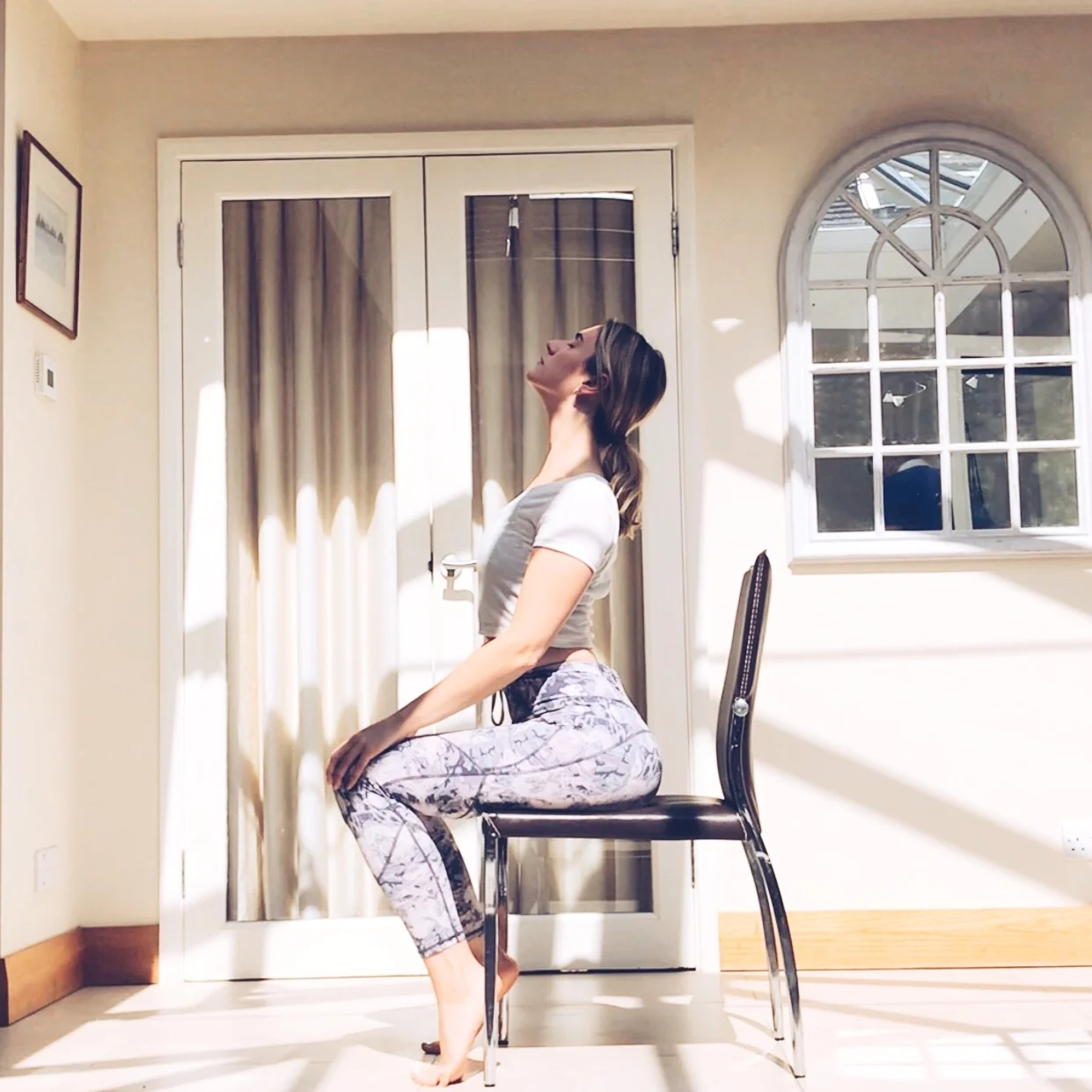
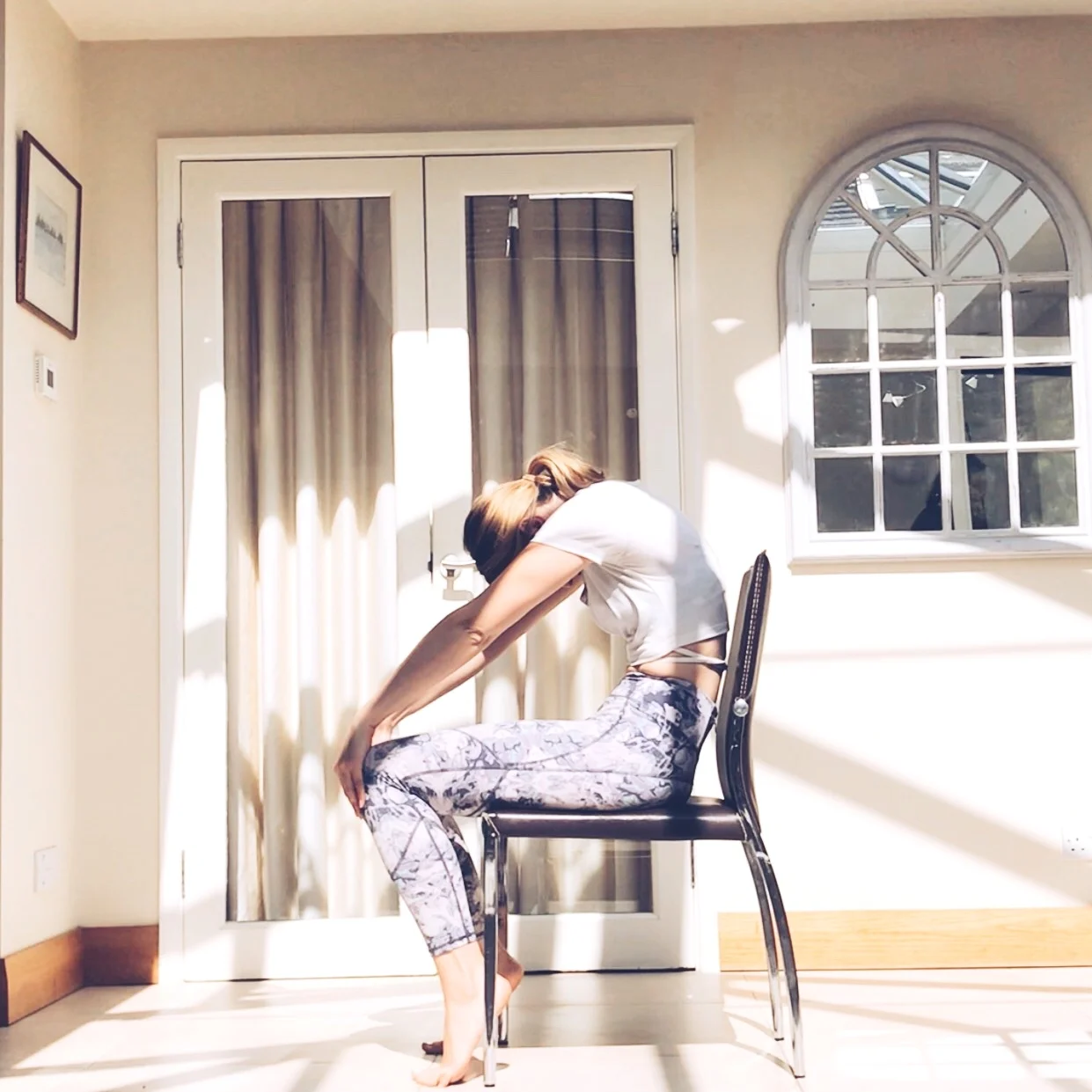
3. Neck Stretch
Take your hands under your thighs and sit up as tall as you can. Let the right ear drop toward your right shoulder, hold here for 30 seconds until you feel a gentle release and repeat on the other side.


4. Reach Up
Take your hands together above your head, interlace them and pop out your first finger pointing to the sky. Stretch arms up as high as you can to lengthen your spine and let your self stretch right and left, staying on one side for a few moments.

5. Seated Twist
Take one hand behind you to the top of the chair and the other to the arm rest or the side of the seat. Lift up as tall as you can, take a breath in and twist as you breathe out. Hold it for at least 30 seconds, keeping long through your spine. Release and repeat on the other side.


6. Hip Opener
Take your right ankle over the top of the left thigh and flex the foot. Gently draw the right knee towards the ground, hold the knee and ankle and hinge forward. Hopefully you feel it in your outer right hip. Repeat on the other side.

7. Eagle Arms, Upper Back Stretch
Reach your arms to each side and then wrap the right under the left, bend your elbows, squeeze the arms together and wrap the hands until they touch. Shrug the shoulders down and draw your forearms and hands forwards and up. Hold for 20 seconds and repeat on the left side.
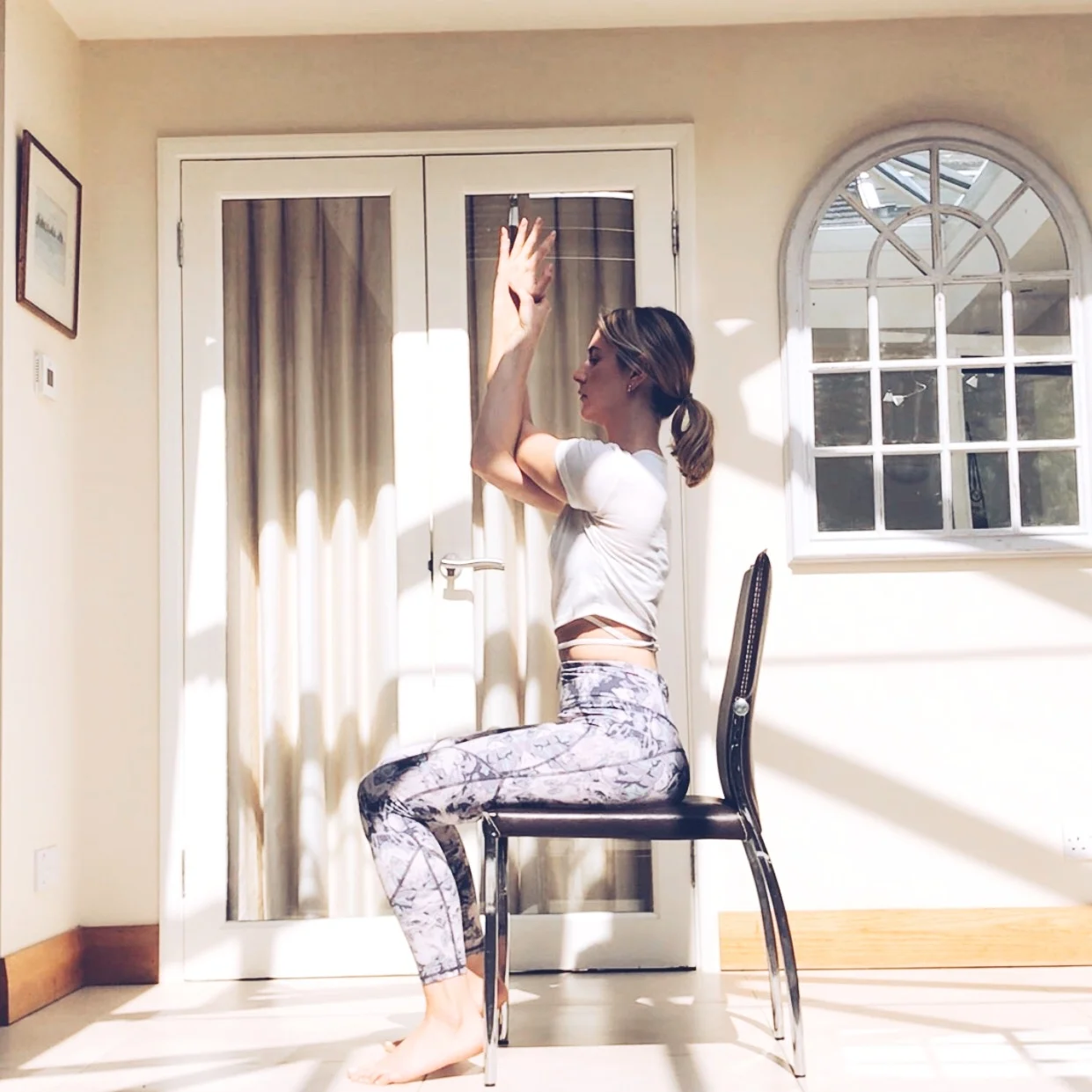
8. Calf Stretch
Come to stand, bend through one knee and place the other heel on the ground, flexing that foot. Hold on to the desk or the back of your chair and slowly fold forward.
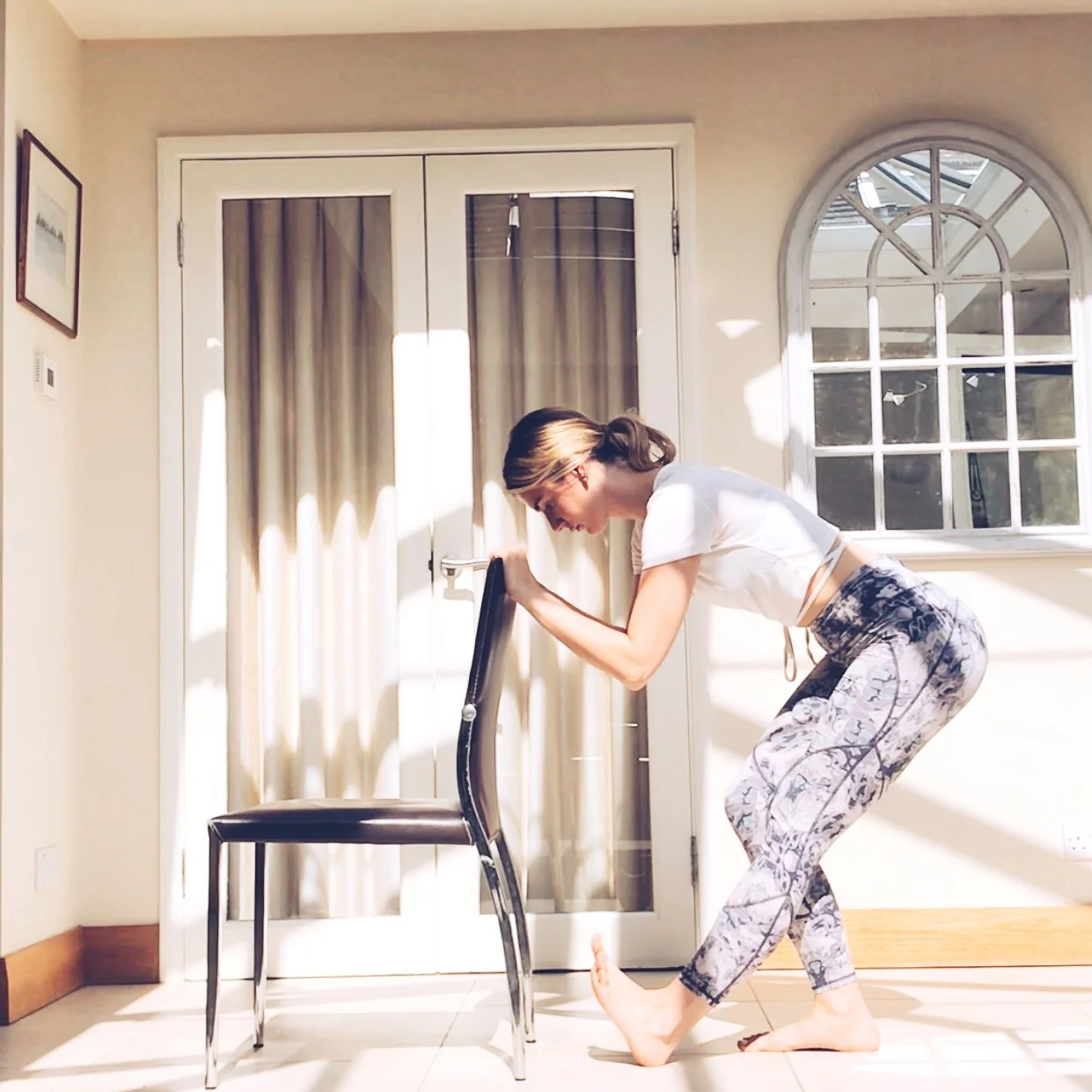
9. Quad Stretch
Stand tall and take the weight into one foot, lift the other and bend that knee, catching the foot in your hand. Keep the knees together and draw your hips forward, bringing the heel towards your bottom.

10. Back body and neck
Interlace hands behind your lower back, draw the shoulders behind you, extend arms, lift hands away from body and drop chin to sternum. You can do this sitting or standing at any point of the day and it should release tension in the shoulders and neck.

My Go To Dhal Recipe
Kudos to Jasmine Hemsley for this recipe, it’s so simple and so warming.
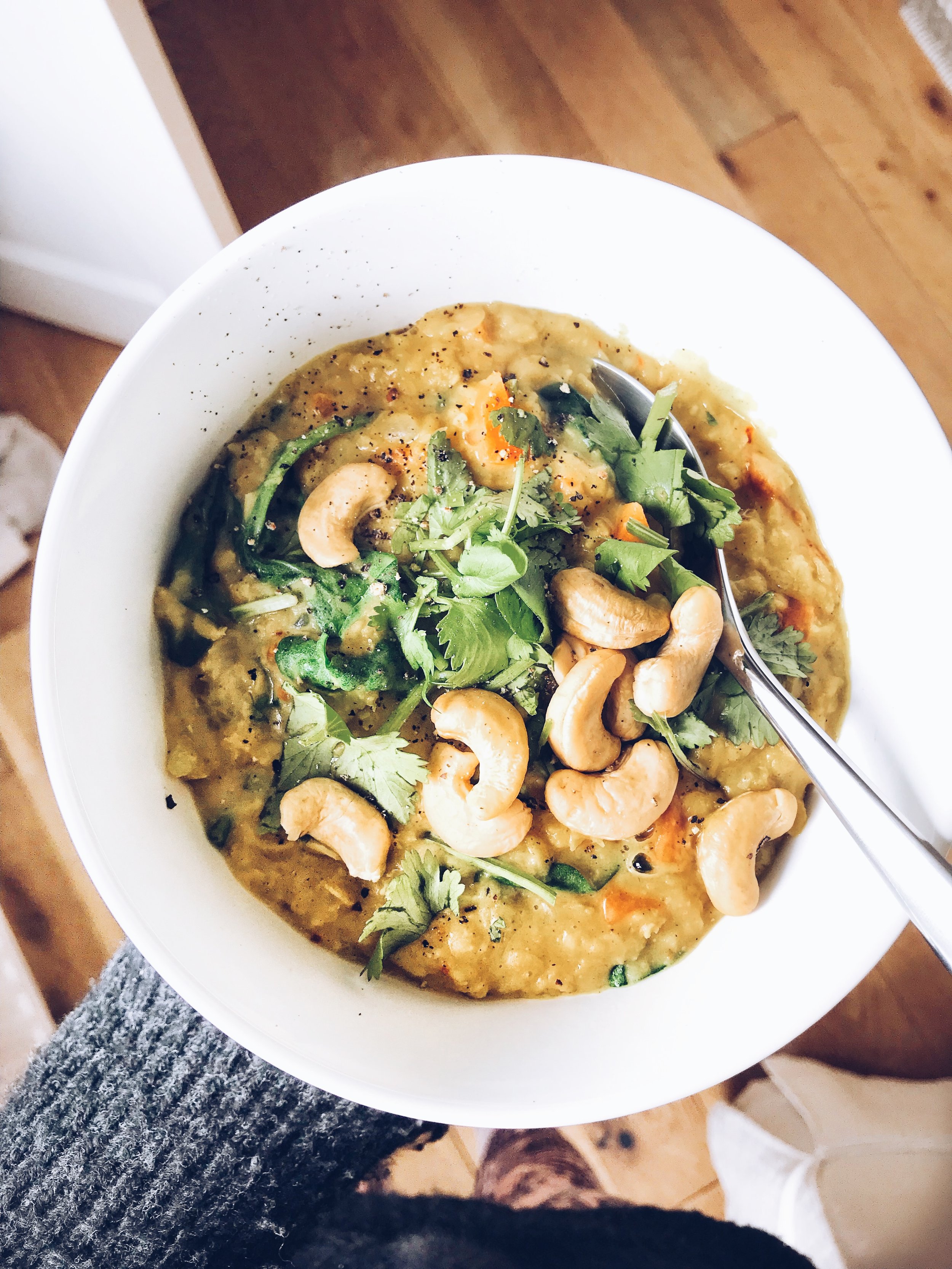
Kudos to Jasmine Hemsley for the inspiration for this recipe, it’s so simple and so warming.
—
Ingredients
1 tbsp coconut oil
1 onion diced
2 garlic cloves mashed
3cm ginger
1 tbsp cumin
1 tsp cinnamon
1/2 tbsp turmeric
1 tsp chilli flakes
1 tbsp whole grain mustard
1 diced carrot (I chop it into 1cm cubes)
250g red split lentils
500ml water
400ml tin of coconut milk
10-15 cherry tomatoes
1 lime
coriander
cashews
s + p
Method
Heat coconut oil on medium heat and add onions, soften. Add garlic, chopped ginger all spices and mustard - mix and fry for a minute or two.
Mix in lentils, carrot, add water and coconut milk. Bring to boil and then keep it on a low heat with a lid for 20 minutes until lentils + carrots are soft.
add chopped tomatoes and heat through for 5 minutes then add lime juice.
garnish with chopped coriander and cashews. Salt and pepper if you need. Yum!
—
this recipe is marginally different to Jasmines but I have now made it so many times that THIS is exactly how I would make it and think it’s the most simple yummy thing.
Please tell/tag me @littlehealthbunny if you decide to make it! Enjoy!
kiri xx
Ajna, The Third Eye Chakra
Your third eye chakra is located in the space between your eyebrows. It’s colour is indigo and is sometimes called our sixth sense or psychic chakra. So while your eyes see the material world, Ajna helps you look into deeper realms - creativity, imagination, intuition. Your intuition is what encourages you to make decisions with feelings that you’re drawn to, even when your conscious and logical mind wants to resist.
Your third eye chakra is located in the space between your eyebrows. It’s colour is indigo and is sometimes called our sixth sense or psychic chakra. So while your eyes see the material world, Ajna helps you look into deeper realms - creativity, imagination, intuition. Your intuition is what encourages you to make decisions with feelings that you’re drawn to, even when your conscious and logical mind wants to resist.
Ajna is associated with the pineal gland, which regulates biorhythms including your sleep and wake cycle. Awakening your third eye allows you to open up to an intuitive sensibility and inner perception.
When this chakra is imbalanced you may feel stuck in the daily grind with an inability to see a path for yourself and be closed minded to see a larger picture.
When it is in balance you will see life with clarity, possess intuition, insight and self awareness.
Mindfulness and yoga are effective ways to open the energy in Ajna chakra; keep your practice focused in the present, on reality. Try the following few poses…
1. Balasana. Child’s pose is perfect to connect the third eye to the earth, take this time to feel grounded, to listen to your breath, your heartbeat. Feel the weight of the skull on the mat and allow the shoulders to relax.
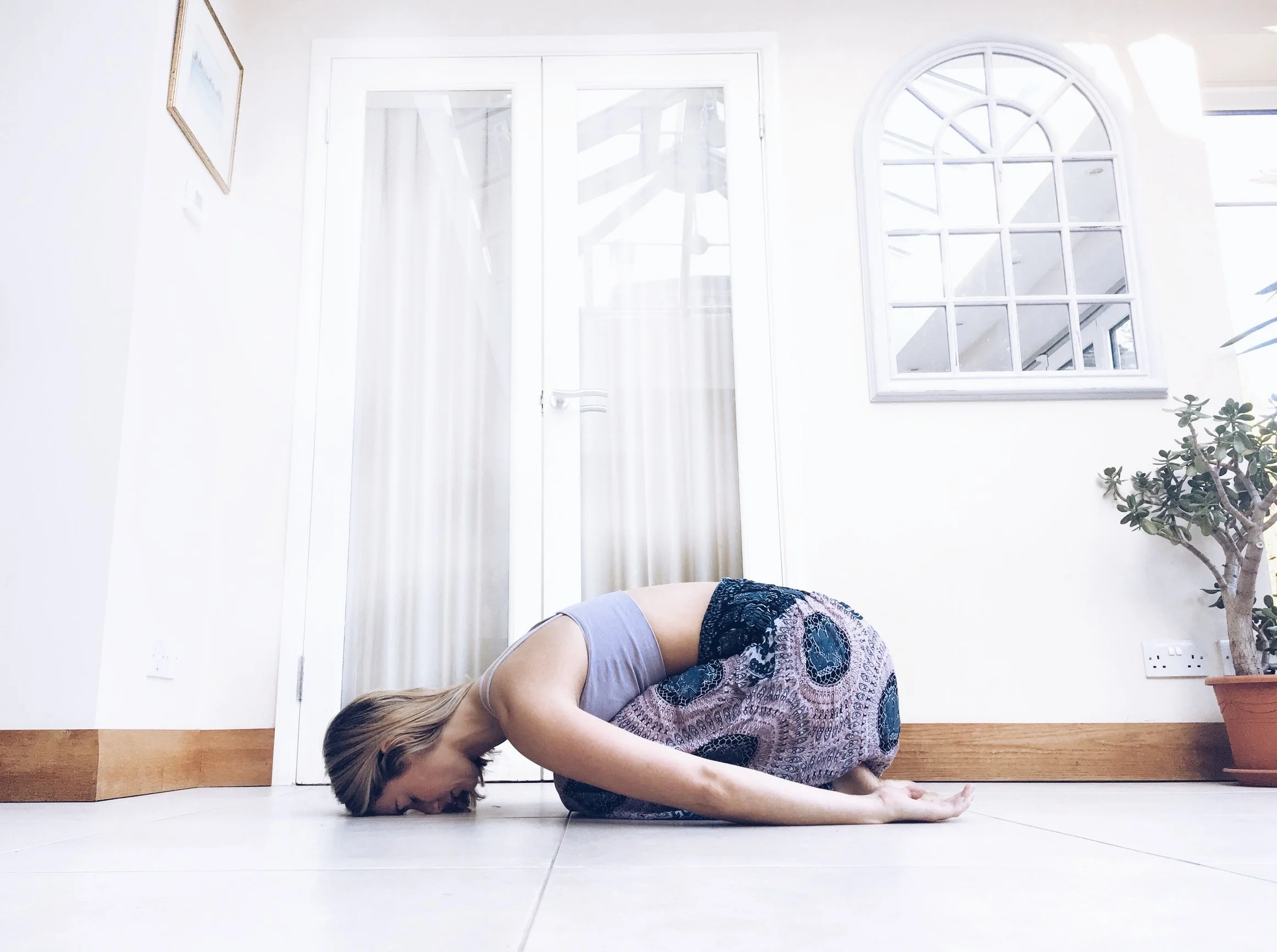
Balasana, Childs Pose
2. Dolphin. Start in downward facing dog and then lower onto your elbows (try to take both down at the same time so that you don’t get a preferred side). Push your forearms into the mat, draw sitbones high and breathe. It doesn’t look too hard but is a strong pose.

Catur Svanasana, Dolphin Pose
3. Eagle. Bend your knees and rock your weight into your left foot, lift the right and wrap it around the left leg. If you aren’t feeling balanced, keep a toe on the ground. Wrap your right arm under the left, squeeze them into one another and lift the elbows up and forward. When balanced, take thumbs to your third eye centre and take five breaths.

Garudasana, Eagle Pose
4. Easy pose for meditation. Take this time to feel into your body, check in with yourself, be in the Present. Sit with your thoughts and watch them as they come in and leave, the ebb and flow. With each inhale, breathing in an open mind, a fresh perspective and with each exhale, let limiting beliefs, strong opinions, negativity leave the body. Allow distractions to come but let them leave just as quickly.

Ardha Padmasana, Half Lotus or Sukhasana, Easy Pose
Along with these yoga poses, other ways to open up your third eye… get into sunlight, explore your limiting beliefs, do a third eye chakra visualisation, use supportive affirmations.
Have a good Friday!
lhb xx
Sahasrara, The Crown Chakra
The seventh, the final chakra. This is located at the crown of your head as well as the area just above. It is the center for deeper connection with ourselves and with a force greater than us.
The seventh, the final chakra. This is located at the crown of your head as well as the area just above. It is the center for deeper connection with ourselves and with a force greater than us.
if it is in balance, you will feel at peace, in bliss, happy in stillness and have a great connection to the divine. Unbalanced, you may feel confused, greedy, insensitive, spiritual cynicism. Physically you may also find yourself with migraines, emotional depression and an inability to focus.
Inversions are great at connecting the body to Sahasrara chakra so if you can get into a headstand, handstand or shoulder stand. If one of these isn’t available to you, taking your legs up a wall and being comfortable with cushions, blankets is perfect.
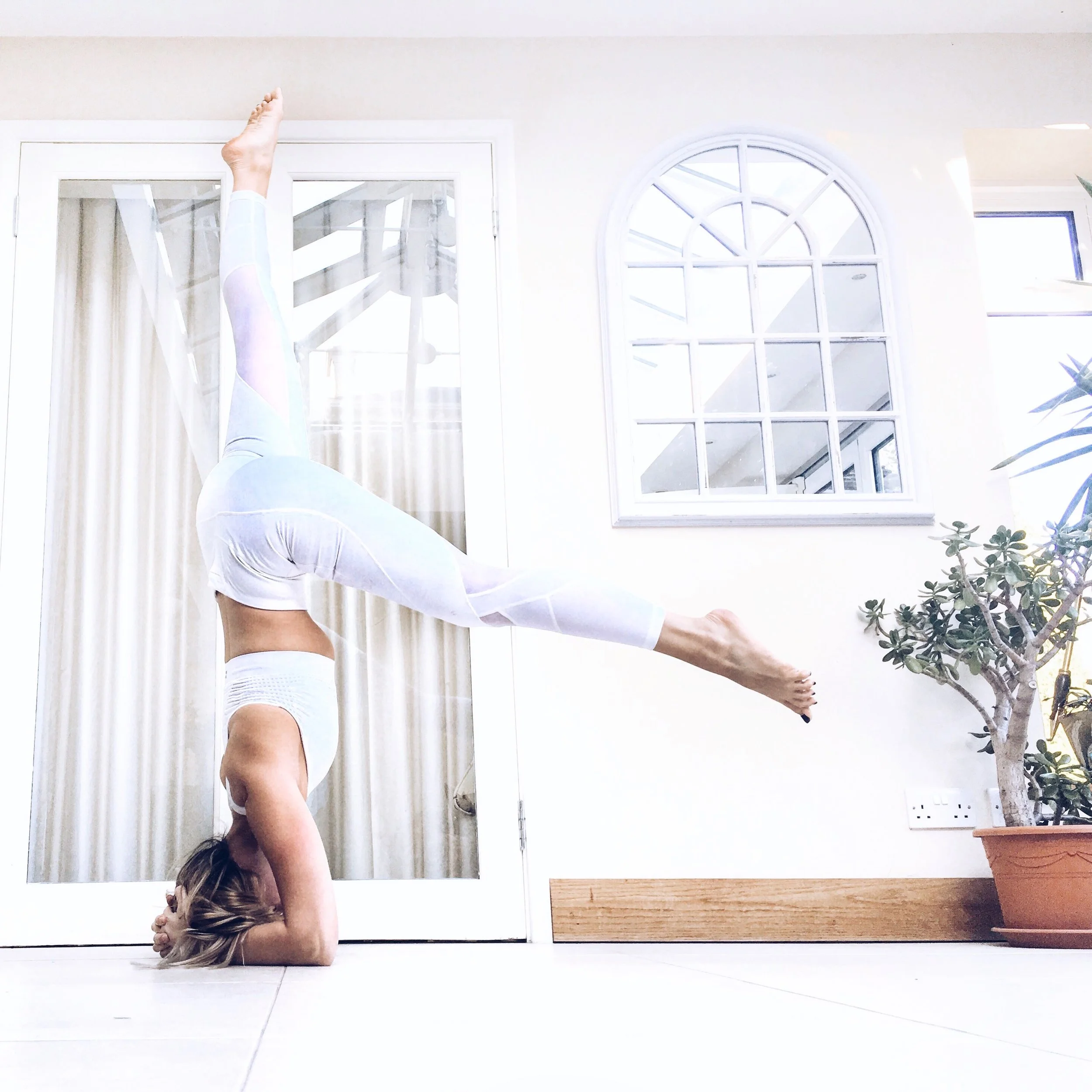
The most practical way to connect with the seventh chakra is through meditation.
Come into a comfortable seat or perhaps into savasana (lying down) if that feels best. Bring your awareness to the crown of the head… take a bright white light to this area, feel softness and warmth flooding from the crown down through the head, torso and legs. Try to focus for at least five minutes and see in time if you could gradually bring it to 20. A guided meditation that I love to do is one by Cat Meffan here.
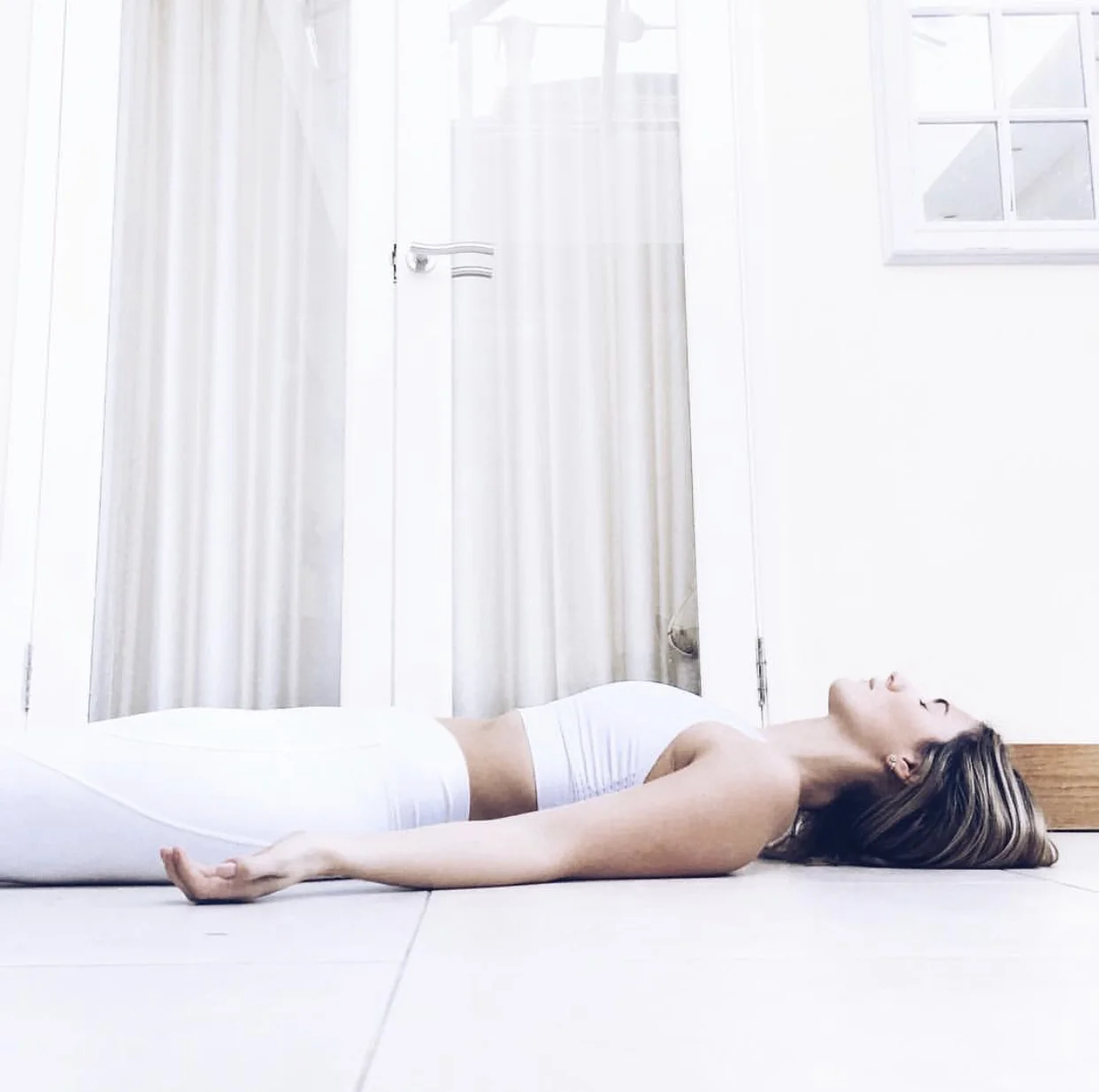
Contact me if you have any questions about this chakra. We will be focusing on this for our classes during the week commencing 25th of February where we will have an extra long savasana propped up with blankets and eye pillows.
join me, Kiri, for classes on Mondays, Wednesdays or Thursdays at my home studio in Tunbridge Wells. For my full schedule or to book a class, click here.
Kiri xx
Vishuddha, The Throat Chakra
Vishuddha is the energy center of communication, expression, and rationality. It is the fifth of the chakras and acts as a link between the heart and the head, between emotions and rationality. It’s colour is blue and it’s element is ether. In balance, it enables you to communicate with ease, honesty and to show the truest version of yourself.
Vishuddha is the energy center of communication, expression, and rationality. It is the fifth of the chakras and acts as a link between the heart and the head, between emotions and rationality. It’s colour is blue and it’s element is ether. In balance, it enables you to communicate with ease, honesty and to show the truest version of yourself.
When your throat chakra is out of balance you may find it difficult to communicate and have an inability to express yourself, which consequently puts one’s identity at risk. If it is too strong it could manifest itself in dominance, supremacy or manipulation and if too weak it may manifest as shyness, awkwardness or fear of conflict.
On a physical level, health problems with the throat neck or teeth could be down to a blocked throat chakra. Moving the neck and opening the shoulders are effective to open up Visshudha. So below are four poses I find help to strengthen this Chakra.
1. Neck Release. The median nerve runs from the neck all the way down the arm to the fingers. This stretch is great to reduce the chances of getting tennis/golfers elbow and reduce tightness in the neck. Using this pose below, making space in the neck, applying gentle pressure on the side of the head and lengthening the arm should tap into the median nerve. To deepen this you can flex your extended hand, point the fingers to the sky and also you could pop the hand against a wall, whilst maintaining the same neck tilt.
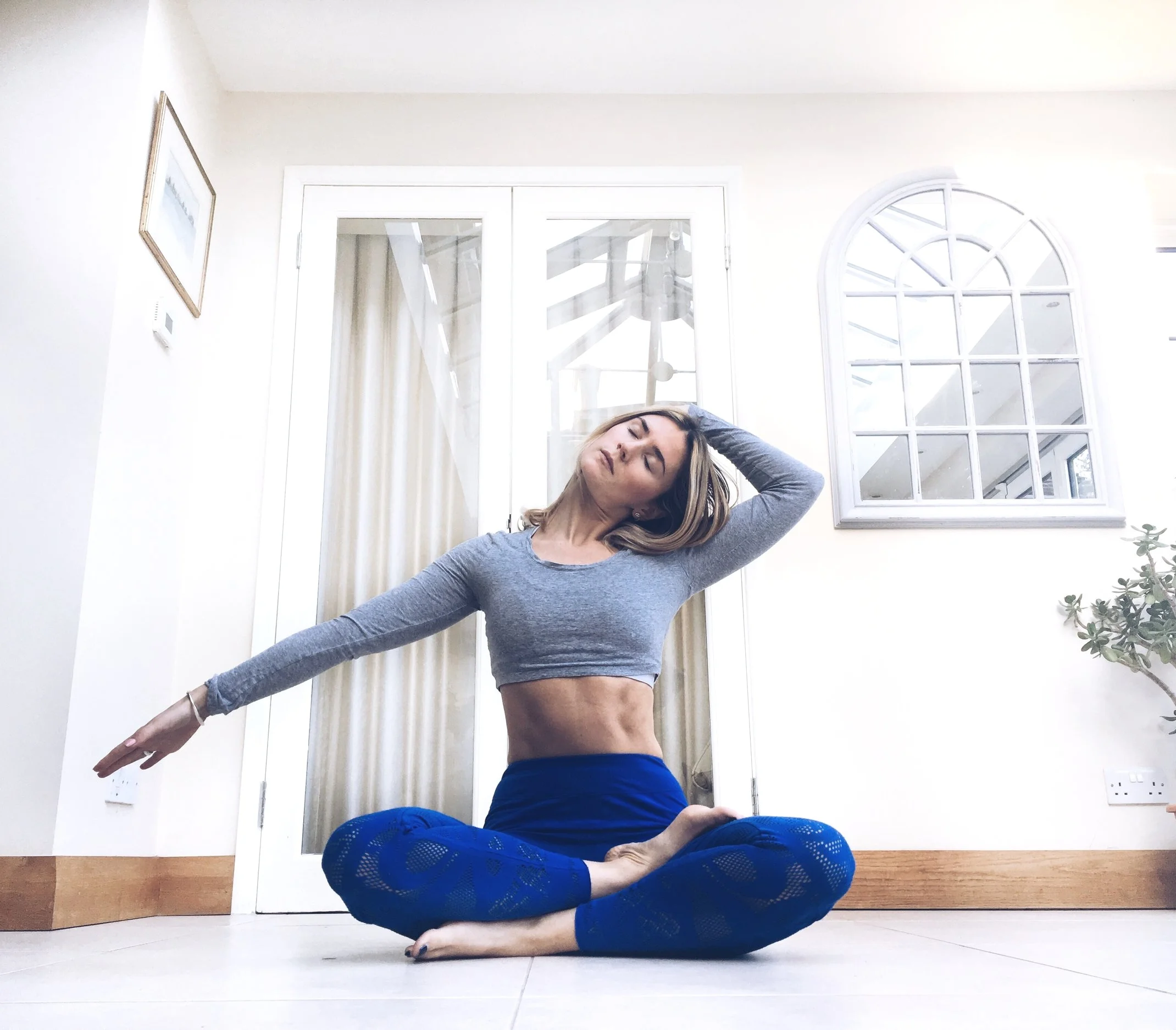
Neck Release.
2. Bitilasana. This pose is often used in conjunction with cat pose, Marjaryasana - moving from one to the other using breath as a guide. Starting on all fours, hands under shoulders, knees under hips, drop the belly button to the earth, tilt the tailbone to the sky and open your heart forward. To invigorate the cervical, upper spine, let your neck join into the movement so long as it is comfortable.

Bitilasana. Cow Pose.
3. Salamba Sarvangasana. If you are ready for an inversion, this is a fantastic pose to strengthen the spine, core, legs and neck. It activates Vishuddha, reverses circulation and sends fresh blood to the throat. Please warm up a little through the neck, back and hamstrings before trying a shoulder stand, it is a test for your posterior chain (back body). And it is VERY important to keep your gaze forward to the sky, giving as little movement to the neck as possible. You are compressing your neck so be mindful. Lying down, rock your legs up and back behind your head, take your hands to the lower back and draw your elbows towards one another for stability. Lift the feet to the sky, point the toes, activate the legs and draw your hips towards the top of your mat (your head), whilst keeping toes high. If you feel good, staying here for 2-5 minutes, taking deep breaths.

Salamba Sarvangasana. Shoulder Stand.
4. Karnapidasana. This is a fairly advanced pose and will stretch your posterior chain. Coming from lying down, rock your feet up and behind you. Begin by extending the legs long if the hamstrings allow and then bending the knees, guide them down towards your ears. To modify, keep your hands on your lower back to offer support. Like a shoulder stand, it’s so important to maintain a forward gaze with as little movement through your neck as possible. This pose stimulates the thyroid gland and activates the fifth chakra.

Karnapidasana. Knee to Ear Pose.
Be careful when trying the last two, take your time and warm up sufficiently!
Kiri xx
Anahata, The Heart Chakra
The heart chakra is unsurprisingly located in the chest, close to the heart and is the fourth of the chakras - balancing the lower three and upper three. It’s colour is green and the corresponding element is air, which represents freedom and expansion. Air, like love, is within and all around. Anahata chakra is unconditional love and joy.
The heart chakra is unsurprisingly located in the chest, close to the heart and is the fourth of the chakras - balancing the lower three and upper three. It’s colour is green and the corresponding element is air, which represents freedom and expansion. Air, like love, is within and all around. Anahata chakra is unconditional love and joy.
When Anahata energy is blocked or unbalanced you may feel shy or lonely with an inability to trust yourself or trust others. It’s difficult to forgive others, you may lack empathy, as well as deep jealousy or harsh judgment on others. And generally this all boils down to repressed emotions from past events. When aligned you feel surrounded by love, compassion, joy and a connection to the world and others around you.
Since the chakras are intricately linked, the opening and balancing of one chakra understandably benefits energy flow through the rest of the chakras. Most chakras for the heart chakra strengthen the circulatory and cardiovascular systems.
Poses that strengthen and expand your shoulders and chest are perfect heart openers and here are 5 of my favourites…
1. Upward Facing Dog or Cobra are fantastic to broaden the chest, stretch the lungs, promote spinal and arm strength which also invigorates the circulatory system.

Urdhva Mukha Svanasana, Upward facing dog.
2. Malasana with an open twist. This is one of my favourite poses which allows the hips to open up and give leverage to really stretch out the chest and shoulders. Take 5 breaths here.

Malasana, Low Squat.
3. Wild Thing is translated as “the ecstatic unfolding of the enraptured heart." Start in downward facing dog, roll your weight into the right hand and the outside of the right foot into side plank. Step the left foot behind with a bent knee and once you’re balanced on the feet and right hand, press the hips to the sky and sweep your left arm back to open the chest and heart.

Kamatcarasana, Wild Thing pose (Feat Luna)
4. Camel strengthens your lower back, thighs and legs whilst opening up the chest and heart. Start on your knees and bend back on each side at a time before bringing both arms back. Either keep the chin close to your sternum or rock it back and open the throat if it feels comfortable.

Ustrasana, Camel pose
5. Wheel pose strengthens your legs, arms, abdomen and spine.
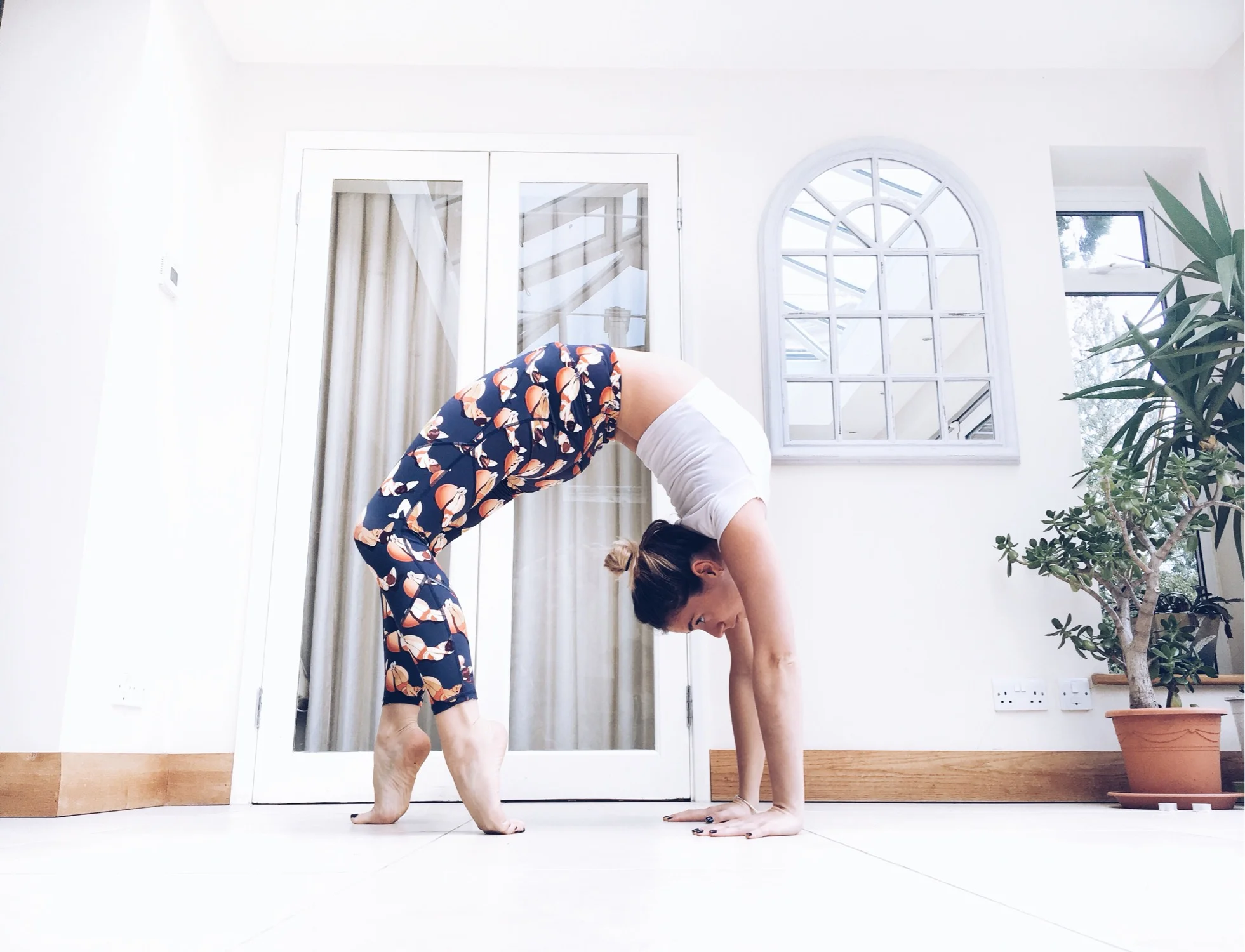
Urdhva Dhanurasana, Wheel pose.
Join me on the mat this week to open up your heart chakra and cultivate some compassion and kindness. Classes take place in Tunbridge Wells, Kent and all abilities are welcome. Book here to attend or email to ask any questions you have.
Kiri - LHB x
Manipura, The Solar Plexus Chakra
The core of our personality, our identity, our ego is what is found in the solar plexus chakra. It’s the perception of who we are, our willpower, self discipline.
The core of our personality, our identity, our ego is what is found in the solar plexus chakra. It’s the perception of who we are, our willpower, self discipline.
It’s colour is yellow and it’s element is fire, located just above your navel (belly button). It translates as “city of gems”… which at first made no sense, however I’ve since embraced that simply as “something very precious”. And Manipura is the one chakra that will have the biggest impact and directly benefit from a healthy diet because it involved the digestive organs.
When Manipura is strong and balanced, you will move forward in life with confidence. You can build plans into reality, be assertive and have effortless relationships with those around you. If it unbalanced or blocked, you may misuse your power to manipulate or to control others. And there may also be a feeling of helplessness, lack of direction or formulating ideas but having no idea how to put them in to action. To build your third chakra, you need to have self love and self confidence and doing the following poses should help too…
1. high plank. Push the ground away to draw your shoulder blades up to the sky. Engage your core and don’t let your hips weigh down. Keep the body in a long line from your heels to the crown of your head.

Plank Pose
2. Dhanurasana. This pose is quite specific to open up the third chakra. Bend your knees to take hold of the pinky edge of your feet. Kick your feet into the hands and this will lift the chest off the floor. If you want deepen the pose, push your feet harder into the hands and point the toes to the sky. Visualise the colour yellow as you soften your gaze forwards.
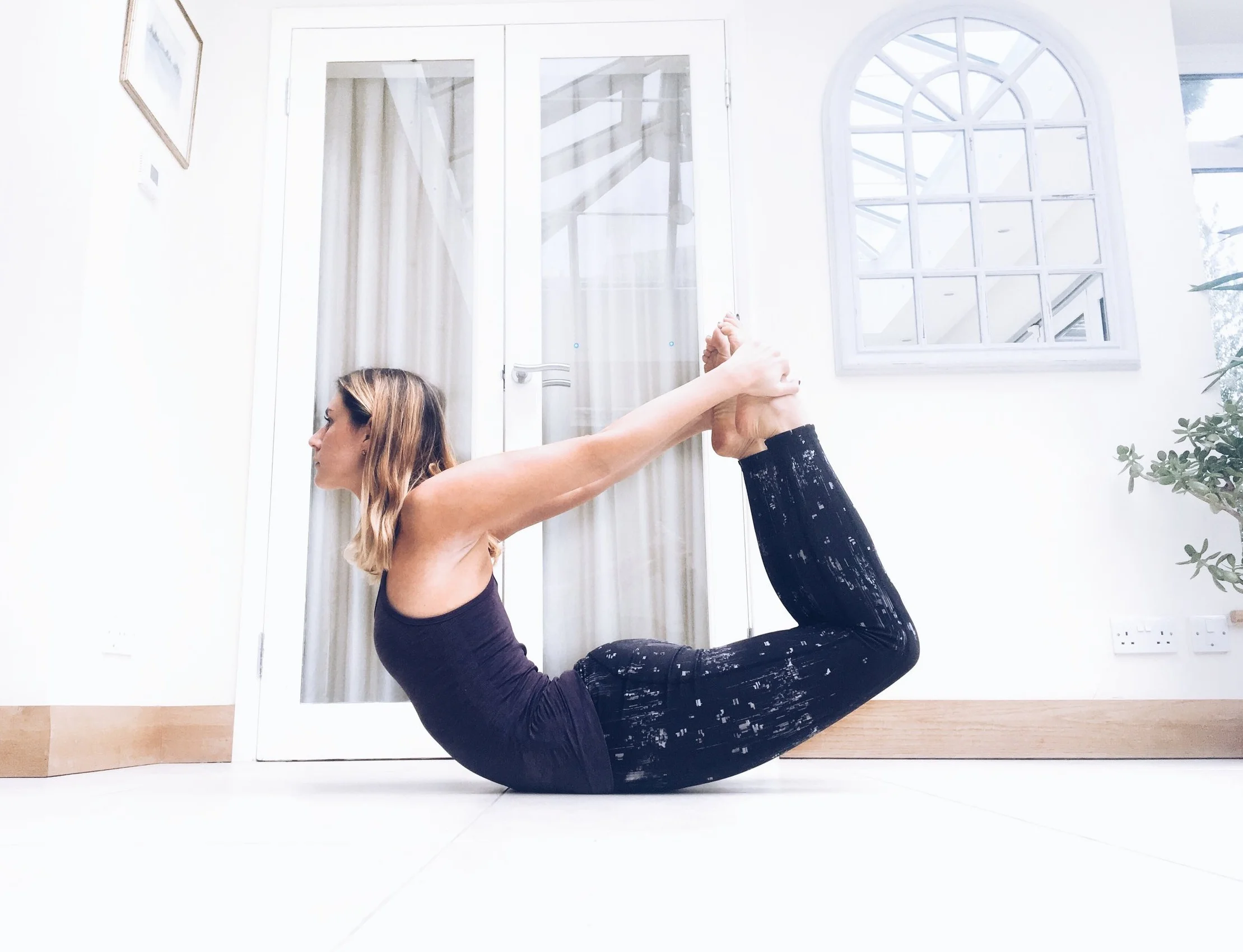
Dhanurasana, Bow Pose
3. Virabhadrasana 3. Warrior three is a balancing pose which engages the abdominals. Shift balance into one foot and bring the other out behind you. Flex this foot, pointing the toes to the floor and slowing lift it as you also lower your torso toward the ground, finding an equilibrium. Keep the spine long, creating a long line from the heel to the crown of your head. Vary your arms by bringing them down by the sides or reaching forward to fire up the core even more, or use this variation in the photo below.
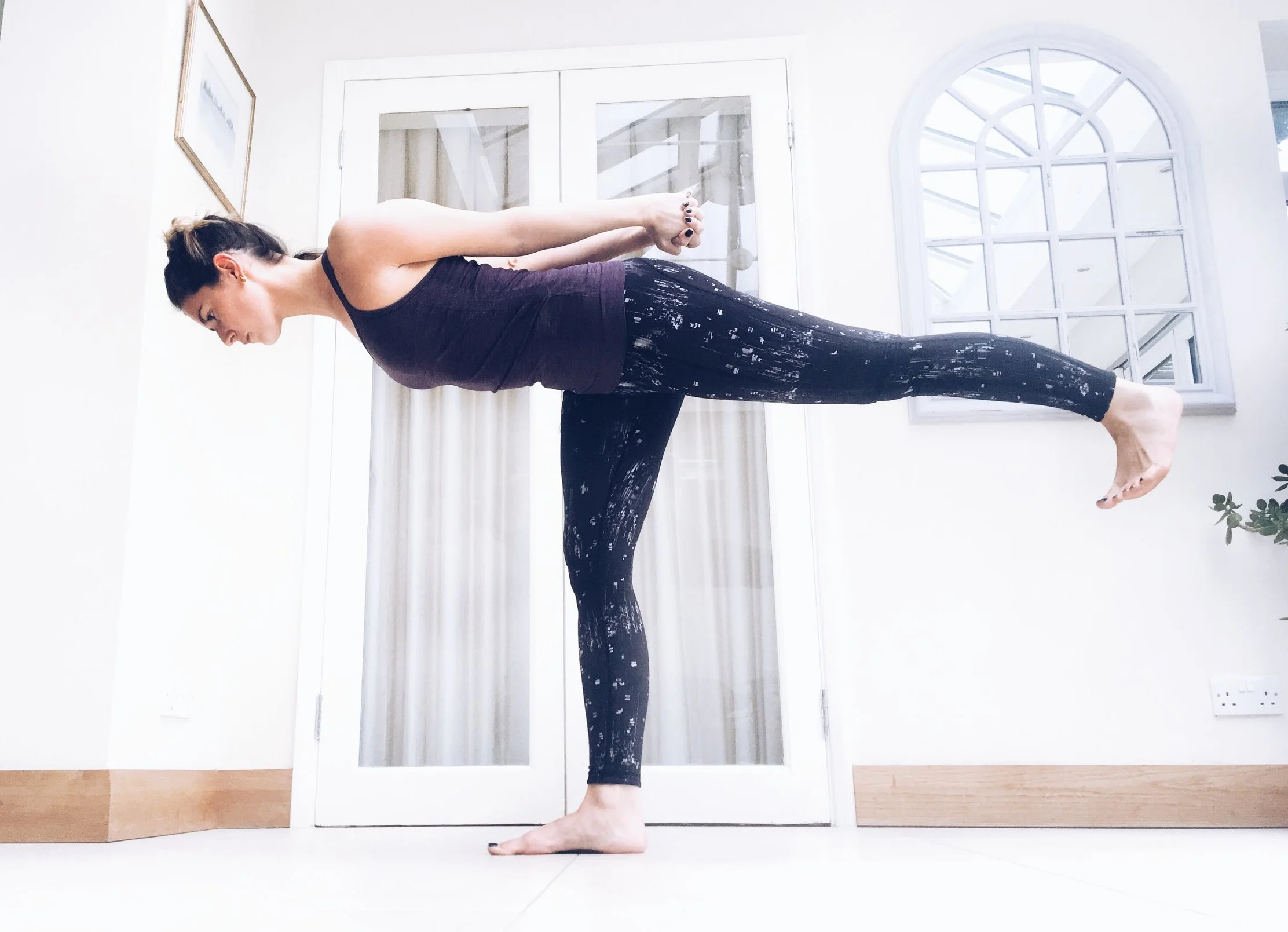
Virabhadrasana III, Warrior Three
4. Any twist will engage and bring energy to the solar plexus. A seated twist or a twist lying down is perfect. Twists wake up your digestive system and encourage a healthy gut.
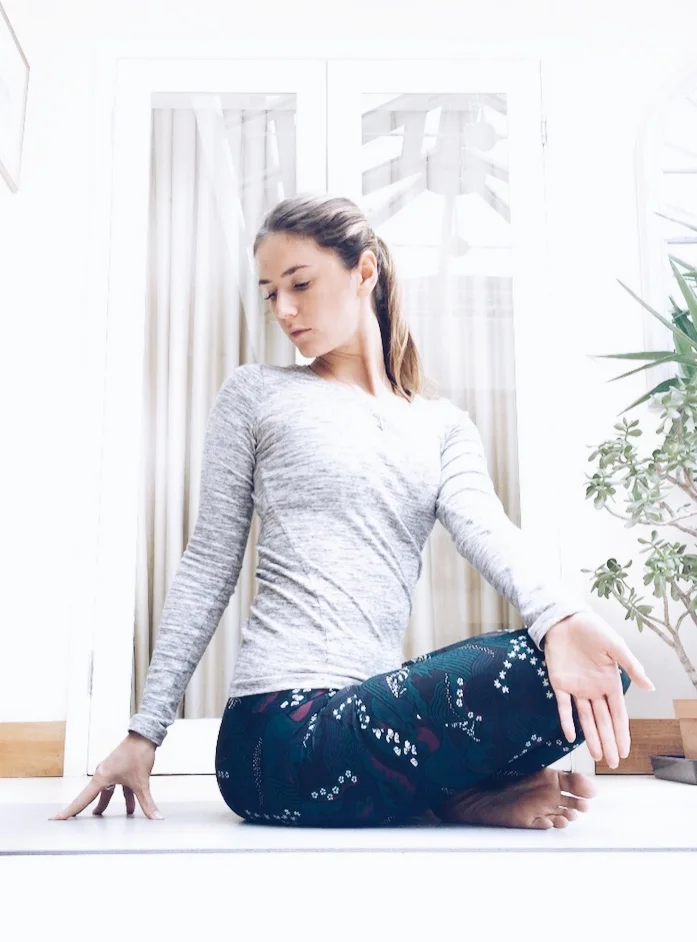
Seated twist
Use these poses to fire up the solar plexus chakra, open it up and gain some abdominal strength. Join me in classes this week to delve in to Manipura chakra, building heat whilst it snows outside!
Contact me on kiri@littlehealthbunny.com to ask any questions about yoga or book here if you’d like to join me in a yoga class in Tunbridge Wells.
Kiri - Little Health Bunny x
Svadhisthana, The Sacral Chakra
The second of the seven chakras, Svadhisthana. It’s colour is orange and is located just below your navel. It is associated with your emotional, creative, sensual, sexual side. It’s element is water which makes sense because it is about fluidity; the ability to go withe flow. Svadhisthana is a combination of two Sanskrit words, “one’s own” (Sva) and “abode/seat” (Adhisthana).
The second of the seven chakras, Svadhisthana. It’s colour is orange and is located just below your navel. It is associated with your emotional, creative, sensual, sexual side. It’s element is water which makes sense because it is about fluidity; the ability to go withe flow. Svadhisthana is a combination of two Sanskrit words, “one’s own” (Sva) and “abode/seat” (Adhisthana).
When this chakra is blocked you will lack in creativity, have repressed emotions. In addition, physical attributes may entail contracting UTI’s, having a low libido or perhaps lower back pain. When it flows freely you will have creativity, desire, healthy relationships and the ability to embrace pleasure.
In order to use yoga to balance this sacral chakra, hip opening poses and forward folds are recommended. They tend to involve fluid movements such as cat-cow and barrel rolls (moving the hips or the rib cage around in circles).
The following poses are involved in our practice this week and will tap into the Svadhisthana energy.
1. Anjaneyasana. A low lunge is a good place to begin; warming up the quadriceps and psoas muscles. Draw your tailbone down and forward, but tuck your pelvis forward so that you keep a deep stretch in your back hip flexor.

Anjaneyasana, Low Lunge
2. Ardha Hanumanasana. Alternate between a low lunge as described above and a runners lunge to get deep into the hips and move fluidly through both, inhaling in a low lunge and exhaling into runners lunge. Tip: pop a blanket under your knee.
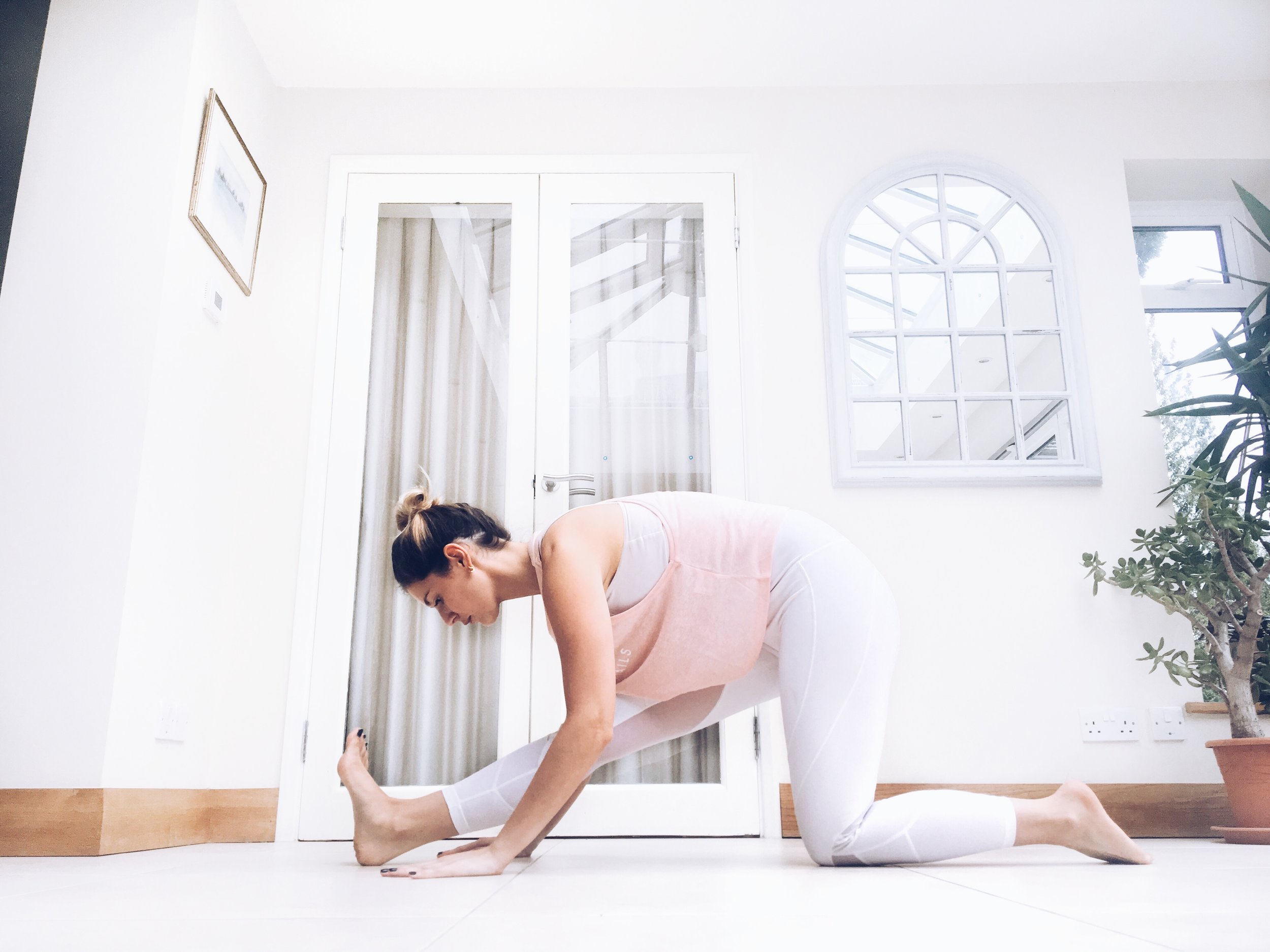
Ardha Hanumanasana, Runners Lunge
3. Mandukasana. Pop onto your knees (again a blanket might be helpful) and face the side of your mat. Spread your knees as wide as they can go but keep the pelvis in line with the knees. Bring your hands or forearms to the ground and BREATHE. Frog pose is a difficult and fairly mind numbing pose for me; I find it hard to relax my body into it. This is a fantastic yin pose, so staying in this pose drawing your pelvis towards the ground for 2-5 minutes will do wonders for your hips.

Mandukasana, Frog Pose
4. Prasarita Padotanasana offers you a hip opener with a forward fold. Take your hands to your hips or reach down to the floor, drawing your heart to the ground with a relaxed neck.

Prasarita Padotanasana, Wide Legged Forward Fold
5. Utkata Konasana, Goddess Pose brings strength to the legs. Open the hips by drawing your knees back behind you, making space in the front of your pelvis. Sit up tall and anchor your tailbone down toward the earth, relax the shoulders but lengthen the spine.
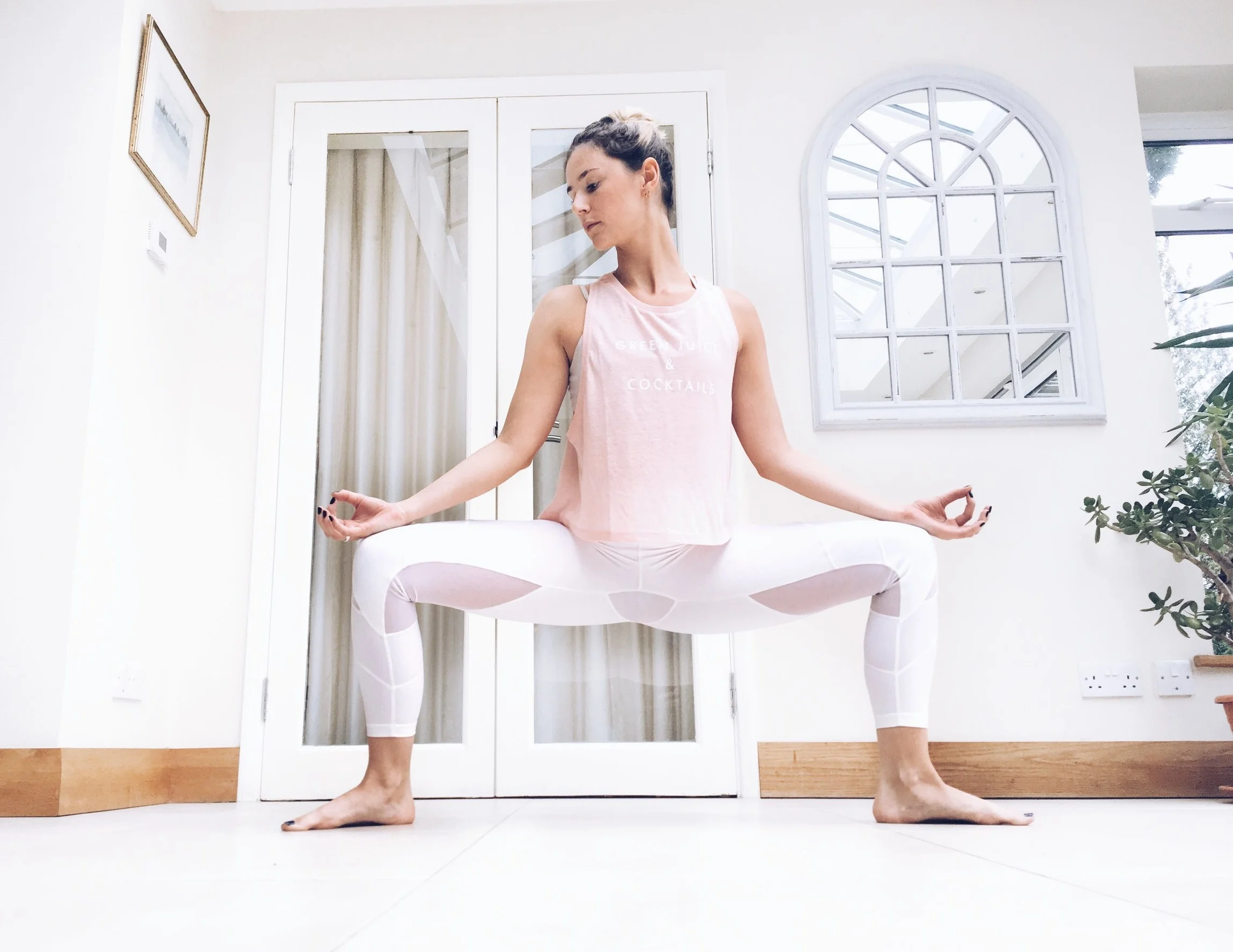
Utkata Konasana, Goddess Pose
These are just a handful of poses to encourage energy to the sacral chakra. Come and join me this week for juicy hip openers to delve further into and deepen your understanding of the second chakra, Svadhisthana.
For more information on my class timetable or to book for yoga with me in Tunbridge Wells, click here.